

Jan 5, 2026
Digital Marketing
Prepared by Kendra Richards
The new guide at https://accessability.rgd.ca/ unifies principles, examples and tools to make accessible graphic design part of everyday work. Aimed at professionals, educators and clients alike, the resource aims to build a more open world, reinforcing that accessible design is for everyone.
Below are their practical examples of how to make written content more accessible.
Designing for accessibility means ensuring the largest possible number of people can access the same information. This inclusive approach benefits individuals with disabilities, those in diverse circumstances (like parents or grandparents) and our future selves as we experience unexpected changes over time.
“The one argument for accessibility that doesn’t get made nearly often enough is how extraordinarily better it makes some people’s lives. How many opportunities do we have to dramatically improve people’s lives just by doing our job a little better?” – Steve Krug
Language often presents the first hurdle to accessibility. Complex language heightens cognitive load. To ensure clarity and avoid needless jargon and complexity, use plain and clear language, particularly for complex subjects.
For text content to be scannable, it needs to be written with an understandable and predictable structure and hierarchy. Implement a clear linear progression of ideas and avoid needlessly complex sentence and paragraph structures. Break up long passages of text into smaller sections with meaningful subheadings.
Choose shorter words over longer ones if the content’s meaning remains clear. Eliminate any unnecessary words that don’t add to the meaning. This improves clarity and reduces your reader’s cognitive effort.
Avoid using idioms. Write everything as if it will be processed by Google Translate afterwards and you need it to maintain its meaning after any machine translation. Not only is this a practical consideration since online translation services are used by people around the world, this self-imposed limitation can train you to write with greater clarity, precision and ultimately, accessibility.
Avoid needlessly relying on words or phrases that could be considered insider knowledge. This includes, but is not limited to abbreviations, acronyms, jargon and scientific terms. If you need the economy or precision that these terms can provide, define or explain them upon their first instance of usage in a body of text.
There are words that sound nearly identical, but have different meanings, such as “all” and “awl,” “bare” and “bear,” or “to,” “too,” “two,” and “tutu.” For readers who rely on text to speech technology, these homonyms can sometimes cause confusion. To avoid this problem, consider the following:
There are different words that are spelled identically, but their meaning is clarified in speech by differentiated pronunciation. For instance, in the statement “he put a sticker of a bass on the body of the bass,” how do we know if the sticker depicted a fish or a musical instrument? And what exactly did he put the sticker on? Exercise care when using heteronyms.
Avoid incorporating foreign words into your language usage, unless there really is no equivalent word or expression. Native English speakers often needlessly incorporate foreign words or phrases and this can be very confusing for non-native English readers and anyone using a text to speech mechanism.
Pop culture references can be fun and illustrative for those in the know, but for others they can be alienating and confusing. They may also age poorly, decreasing their communicative value and accessibility over time. Never use a cultural reference that your audience might not understand, unless its meaning can be gleaned from context, or it is otherwise explicitly explained.
If a word or phrase is being used that may be unknown to your reader, provide a mechanism to integrate definitions for these terms. Conversely, if you are using a well-known word or phrase with an unusual, limited, or particularly specific definition, you need to clearly define that term’s usage for your reader as well.
In some cases, despite our best efforts, a text may still require a reading ability more advanced than a lower secondary school education level. In these cases, provide either a plain language summary of the complex content, or an alternate version that does not require such a high reading level.
Accessible writing is about making our writing clearer and more inclusive. We can reduce barriers and expand access by choosing our words carefully, structuring content thoughtfully and anticipating how different people read and understand information. These small, practical changes add up to better communication and a more accessible world for everyone.

Why Choose Source Select Marketing?
Our promotions go beyond discounts-they’re strategic opportunities for growth. With savings, referral rewards and customized bundles, we deliver innovative solutions that drive success. Ready to elevate your brand?
Contact us today and experience the Source Select Marketing difference!


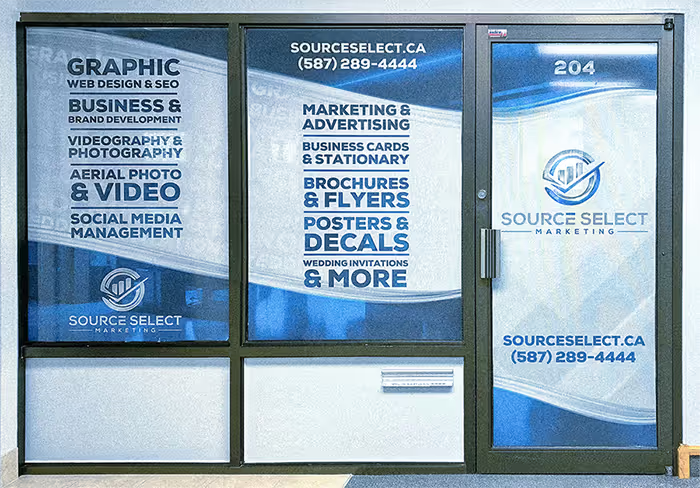
We are a Medicine Hat-based digital marketing firm dedicated to providing effective solutions for businesses across Canada.
Our experienced team delivers impactful results and seamless design.

Monday - Friday (8:30am to 5:00pm)